

Two Riders, One World Championship: Tommy & Sabrina Take on Hokkaido
SOOMOM StoriesAmbassadors · 2026 UCI Gran Fondo World Championships

After months of training, qualifying and preparation, SOOMOM ambassadors Tommy Egan and Sabrina Peng arrived in Hokkaido to represent Australia at the 2026 UCI Gran Fondo World Championships. They shared the same course, the same Australian kit and the same goal of giving it everything they had — but their races couldn't have unfolded more differently.
For months, the World Championships had been something Tommy Egan and Sabrina Peng were working towards.
Training sessions. Long weekends on the bike. Indoor sessions when the weather refused to cooperate. Race preparation, fuelling, recovery and all the small decisions that eventually lead to one morning on a start line.
Sometimes they trained side-by-side indoors, with Netflix playing and a speaker between their trainers.
“Having his presence there also meant I was less inclined to slack off,” Sabrina jokes.
Then suddenly they were in Hokkaido.
And the World Championships weren't something they were preparing for anymore.
They were here.

When Worlds became real
For Tommy, arriving in Niseko was the moment the scale of the event really hit.
Riders from around the world filled the town in their national colours. Different languages, different bikes and some seriously accomplished cyclists — including former world champions, national title holders and ex-professionals.
After qualifying at the Tour de Brisbane, Tommy admits he'd built Worlds into something enormous in his head.
Initially, he wanted to be competitive. Seeing the preliminary start list forced him to recalibrate.
I knew I was a tiny fish in a giant pond. Tommy Egan
By race week, that pressure had changed into something simpler.
Finish the race.
And, if everything went right, sneak inside the top 100.
He would eventually finish 99th.


For Sabrina, who had raced the World Championships the previous year, the experience felt different.
She knew more about what to expect and arrived better prepared.
The moment it became real came the day before the race: collecting her number at the expo, surrounded by riders from around the world, and then pinning that number onto the back of her Australian jersey.
Designing Australia differently
Long before Tommy and Sabrina reached Hokkaido, another part of the project had been taking shape back at SOOMOM.
Their Australian kit.
We wanted it to feel unmistakably Australian without simply repeating the traditional dark green-and-gold treatment.
More importantly, we wanted Tommy and Sabrina involved.
Early concepts were shared with them and we asked for their input on how far we should push the design. One idea came through particularly strongly:
It needed to stand out.
Tommy went as far as exploring the Hokkaido course and surrounding landscape through Google Earth.
He noticed the deep greens of the vegetation surrounding much of the course and wondered whether another predominantly dark green Australian jersey might simply disappear into the landscape — and the peloton.
His feedback was to push things brighter.
Louder. More expressive. Still Australian, but not predictable.
Sabrina shared the same thinking.
We helped with the direction of the design and wanted the colours to pop out, and really loved the final design that SOOMOM came up with. Sabrina Peng
For us, that collaboration became an important part of the project.
Rather than designing something for Tommy and Sabrina, we were designing it with them.
They had earned the opportunity to represent Australia. They were the ones who would wear it at a World Championship.
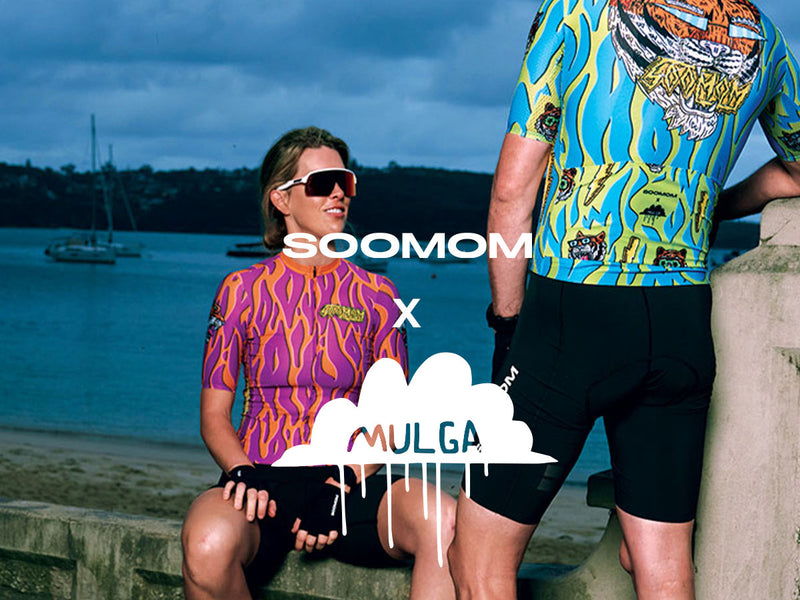
The final combination of lime, yellow, green and white deliberately departed from the darker Australian kits they would be racing alongside.

Once they arrived in Hokkaido, the decision made even more sense.
“The SOOMOM kit stood out,” Tommy says.
He described it as a “bit of a beacon” in the peloton and remembers receiving positive comments from riders representing other countries.
For Sabrina, there was another unexpected advantage.
“It was also easy to find ourselves in the official pictures because of how different it looked to the other Australian kits.”
The idea that started on a screen months earlier was now racing through Hokkaido.


4am. Race day.
Race morning started early.
Very early.
“We woke up pretty early at 4am so we could have time to digest and get some caffeine in,” Sabrina says.
Tommy remembers a bigger-than-usual breakfast as they completed their carb-loading and pre-race routine before pulling on their Australian kits.

Despite everything that had gone into reaching this point, both were surprisingly calm.
“Usually I feel nervous as all hell,” Tommy says. “For this race I felt calm and collected.”
Sabrina felt much the same.
Unlike the Tour de Brisbane qualifier, there was no longer the pressure of needing to qualify. The objective now was simply to race well, finish strongly and see what they could do against an international field.
Their starts were 20 minutes apart.
Tommy headed out first.
“Before I knew it the gun had gone off and we were racing.”
Same course. Two very different races.
Tommy had a plan.
He'd divided the race into five sections and had power, intensity and time targets mapped out.
Stay with the main group as long as possible.
Reach the major climb around the two-hour mark.
Pace the climb.
Descend safely.
Then start applying pressure over the final climbs.
That was the plan.
“Well shit. The peloton was frisky and the pace was insane.”
Within the opening 30 minutes, Tommy was already riding considerably harder than planned.
The early climbs began thinning the field and eventually he made the decision to let the main group go.
What happened next became one of his favourite moments of the entire World Championships.
Tommy connected with another Australian rider before a chase group formed containing Australians, Italians, French riders, a Hong Kong rider, a Dutch rider and a Japanese rider.
Different countries. Different languages.
One objective.
Catch the peloton.
They worked.
And they caught it.
“The chase group I was in worked well together,” Tommy says. “We motored in a smooth-as-butter pace line before catching the peloton in the valley.”
When they reached the back of the bunch, the riders congratulated each other.
For Tommy, that moment would ultimately mean more than his finishing position.

Sabrina's race was unfolding differently.
Around 90 women started together, with a main peloton staying intact through much of the opening 50 kilometres of flatter roads and rolling hills.
When a lead group eventually escaped, Sabrina resisted the temptation to burn too much energy trying to follow.
She knew what was ahead.

A 20-kilometre climb around the 68-kilometre mark, followed later by a much steeper four-kilometre climb averaging around 9–10%.
Her strategy was built around being stronger later.
The long climb naturally spread the riders across the mountain.
Then came the descent.
“I had a lot of fun on the descent down, counter-steering through some nice smooth bends, helping my legs to recover.”
By the second half of the race, the strategy was paying off.
Sabrina began spending more time on the front and, when the final steep climb arrived around kilometre 119, she still had something left.
She led the group of women around her up the climb and through the descent, catching riders from her age category who had climbed faster earlier in the race.

“I definitely rode smarter compared to last year, saving my energy to go more all out in the last 40kms.”
She finished 25th in her age group.
When the race bites back
While Sabrina was becoming stronger, Tommy's race was heading in the opposite direction.
He reached the major climb almost exactly on schedule.
Two hours.
His pacing strategy worked, and eventually he found himself climbing with a French and Italian rider before reaching the summit alone.
The descent that followed had been one of the sections he'd worried about most.
Instead, it became one of his favourites.
His confidence grew through the fast, sweeping corners of Hokkaido.

And, as Tommy couldn't resist pointing out:
“On a cheeky side note, Sabrina usually wipes the floor with me on descents and it was the first time in a while where I managed to descend faster than her! ...but don't tell her that!”
Then, approaching the final two climbs, everything changed.
After taking on fuel, Tommy began dry-heaving.
For the next 40 minutes he struggled to eat or drink properly. His power dropped and what had been a carefully paced race became an exercise in getting himself to the finish.
Then, with around two kilometres remaining, breathing difficulties added another problem.
In the rush of race morning, he'd left his Ventolin back at the accommodation.
A friend, Johnny, realised Tommy was struggling and helped tow him towards the final kilometres.
They crossed the line together.
Both wearing SOOMOM.
Both having finished a World Championship.

500 metres to go
Sabrina still had her own race to finish.
After surviving the final steep climb, she saw the five-kilometre sign.
There was still something left.
“The best moment was seeing the 5km sign and knowing that I had enough in the legs to absolutely push the pace.”
With 500 metres remaining, she spotted Tommy near the final right-hander.
Knowing he'd already finished and was there waiting gave her another burst of energy for the uphill run to the line.

Eventually, they found each other again.
Tommy remembers it as a combination of congratulations and immediate race analysis.
Sabrina remembers seeing him roll back down the hill towards the finish area.
“We immediately talked about how brutal of a race that was and how proud we were of each other.”
There was a hug.
There were highlights.
There were lowlights.
Tommy's stomach.
Sabrina's painfully tender feet.
And, inevitably, there was soon another priority.
Coffee.
Preferably accompanied by something that wasn't sugary or carbohydrate-based.
More than a result
Tommy had arrived hoping to finish inside the top 100.
He finished 99th.
But strangely, that isn't what he remembers most.
“This may sound odd, but I found that a good result for me is not about where I place but how much I enjoyed the ride or race.”
His favourite part wasn't crossing the finish line.
It was the international chase group.
Working with riders he'd never met. Helping others. Sharing the workload and experiencing the camaraderie of racing.
“This race really exposed many of my weaknesses, which was very humbling. It showed me where I need to improve as a rider.”
For Sabrina, finishing 25th in her age group was proof of a different kind of progress.
“I've learned that I really love the process of training for a race and seeing my efforts pay off, even if it just means achieving small goals like feeling stronger in the latter half of the race.”
Both came away thinking less about a single result and more about what the process had taught them.
Hokkaido beyond the race
Worlds may have taken them to Japan.
But the race became only one part of the trip.
There was Lake Toya, where they returned several times to run, ride and explore.


Furano brought lavender fields, hidden cafés and a restaurant they liked enough to visit three times.
There was a tiny coffee shop discovered during a drive where the barista correctly guessed they were cyclists — perhaps, they joked, because of the unmistakable cyclist tan lines.


There were volcanoes.
A lot of volcanoes.
Tommy had always been fascinated by them and suddenly found himself surrounded by Mt Usu, Mt Asahidake, Mt Tokachi and the sulphur vents of Hell Valley.
Sabrina quickly discovered just how enthusiastic Tommy could become when given an opportunity to discuss eruptions.


There were also bears.
Something Tommy admits hadn't really occurred to him before arriving in Hokkaido.
Having grown up worrying about snakes, spiders and swooping magpies in Australia, suddenly seeing bear-warning signs beside riding routes required a small recalibration.
And then there was the cicada.
During a ride in Furano, one managed to lodge itself inside Sabrina's helmet — buzzing away until she came to an abrupt stop to get it out.
Tommy remembers it fondly.
Sabrina perhaps less so.
Their food memories aren't bad either.
A multi-course vegetarian meal prepared for them at a farmhouse. Fresh bread from a self-service bakery in Kutchan. Huge amounts of vegetables. Omurice.
And an extraordinary quantity of carbohydrates in the final days before Worlds.


Hokkaido gave them a World Championship.
But it also gave them a trip neither is likely to forget.
What's next?
Sometimes reaching a major goal leaves a hole afterwards.
For Tommy, Worlds did something else.
It reminded him why he races.
After the Tour de Brisbane he'd begun questioning whether he wanted to continue racing at all.
Training for Hokkaido gave him a target. Racing there gave him the answer.
I feel ready to return to racing. I feel excited to race again. Tommy Egan
Grafton to Inverell is on his radar for next year, along with trying time trialling and hill climbs.
There's also one very specific target.
Sub-40 minutes up Alpe du Zwift.
Current best: 42:38.
Sabrina has caught the racing bug too.
More Gran Fondos. More road racing.
And perhaps some criteriums to work on the part of her riding she identifies immediately as a weakness:
Sprint speed.
In the meantime, the climbing has already started.
Both are racing Zwift's five-week Level Hill Climb Series, which began on 10 September, and both have entered the Australasian Police and Emergency Services Games on the Gold Coast in October.
A little more time in the hills, then.
Two different riders.
Two different races.
One World Championship neither will forget.
And, judging by what's next, Hokkaido wasn't the end of the story.

Follow Tommy and Sabrina's journeys with SOOMOM, and explore more rider stories, technical guides and rides in SOOMOM Stories.